Labour is often spoken about in extremes either something to fear or something to “get through.” In reality, it is neither. It is a physiological process, but also an intensely personal experience, shaped by your body, your mind, your expectations, and the care around you. Pain is part of labour, but suffering doesn’t have to be.
This is where thoughtful preparation and the right choices around pain relief make all the difference.
Understanding labour pain — what is actually happening?
Labour pain is not a single entity. It evolves as labour progresses.
In early labour, discomfort is largely driven by uterine contractions and cervical change. Women often describe this as period-like cramping or tightening that comes in waves.
As labour progresses, the pain becomes more intense and rhythmic. This is due to stronger contractions, stretching of the cervix, and increasing pressure within the pelvis.
In the later stages, particularly as the baby descends, there is a different quality of pain, often described as pressure, stretching, or a strong urge to bear down.
Pain is real but it is also modifiable
Your experience of pain is influenced by multiple factors:
Anxiety and fear
Fatigue and environment
Support during labour
Previous experiences
Sense of control
This is why two women can have very similar labours, but very different experiences of pain.
Good care is not about eliminating all pain. It is about giving you options, supporting your choices, and helping you feel in control.
The spectrum of pain relief options
There is no “right” or “wrong” approach. The best choice is the one that aligns with your values, your labour, and your evolving needs.
1. Non-medical approaches
These are often underestimated, but when used well, they are powerful.
Breathing and relaxation techniques
Slow, controlled breathing reduces anxiety and helps you work with contractions rather than against them.
Movement and positioning
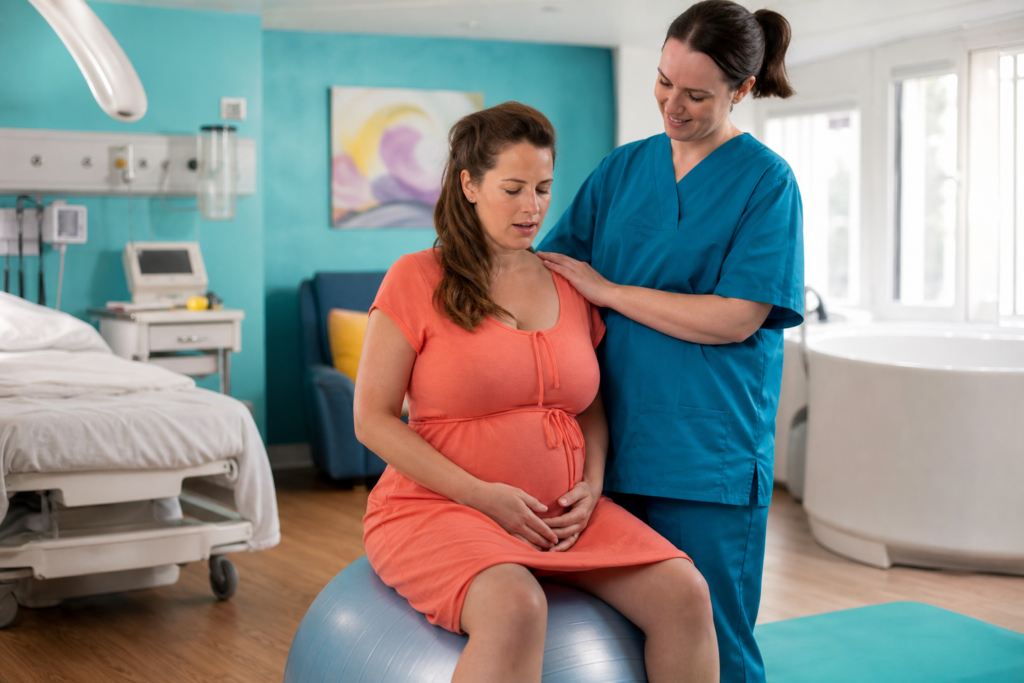
Staying upright, walking, or using a birthing ball can significantly reduce discomfort and help labour progress.
Water (bath or birthing pool)
Warm water can ease muscle tension and create a sense of weightlessness, which many women find deeply relieving.
Massage and touch
Particularly lower back pressure during contractions.
Environment
A calm, private, well-supported setting changes everything. Lighting, noise, and who is present all matter.
These methods are often most effective in early and active labour, and they remain valuable even when combined with medical pain relief.
2. Gas and air (Entonox)
A commonly used option, especially in the UK.
Inhaled through a mouthpiece during contractions
Works quickly and wears off quickly
Takes the “edge” off pain rather than removing it completely
It gives you control, you use it when you need it. Some women find it very helpful; others feel it offers limited relief. Side effects can include light-headedness or nausea.
3. Opioid injections (e.g. Pethidine)
Given as an injection into the muscleedge
off pain rather than removing it completely
Provides systemic pain relief and often helps with rest in early labour
It does not remove pain entirely, but can make it more manageable. It may cause drowsiness, and because it crosses the placenta, timing is important.
4. Epidural analgesia
This is the most effective form of pain relief available in labour.
A small catheter is placed in your lower back
Local anaesthetic is continuously infused
Significantly reduces or removes pain from contractions
For many women, an epidural transforms the experience particularly in long or complex labours.
However, it is not a completely passive intervention. It requires:
Continuous monitoring
Reduced mobility
A small increase in the likelihood of assisted delivery
In experienced hands, it is a very safe and well-established option. The key is to choose it for the right reasons, not out of fear or misinformation.
Choosing what is right for you
This is not a decision you need to make once and rigidly stick to.
Labour is dynamic. What feels right at the beginning may change as things evolve.
Some women come in wanting a low-intervention birth and choose an epidural later, that is not failure. It is responsiveness.
Others plan for an epidural and find they cope well without it, that is not something they “missed out” on. It is simply their experience.
The aim is not to prove anything. It is to have a safe birth where you feel supported, respected, and in control.
The role of support — often underestimated
One of the most powerful “pain relief tools” is continuous, calm, informed support.
Whether that is your partner, a midwife, or your consultant having someone who:
Explains what is happening
Anticipates what may come next
Advocates for you
Keeps the environment calm
…can significantly reduce anxiety and, in turn, reduce perceived pain.
A final thought
Labour is not a test of endurance. It is a transition, physical, emotional, and deeply human.
Pain relief is not about choosing the “strongest” option or the “most natural” one. It is about choosing what allows you to progress through labour with confidence and dignity.
When you are informed, supported, and given real choice, labour becomes far less about fear and far more about trust in your body and the team around you.
See an Obstetrician?
We’ve made it simple for you to schedule an appointment right away via Whatsapp.