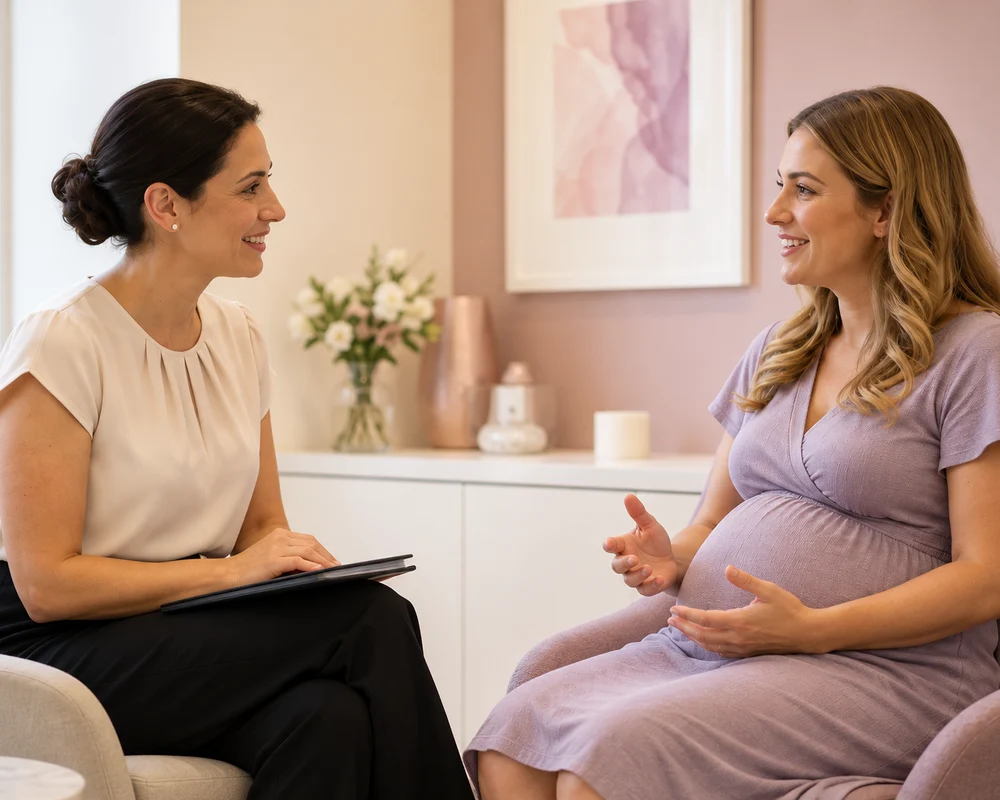
Labour is something your body has been preparing for throughout your entire pregnancy, guided by an intelligence that is ancient, elegant, and entirely your own.
As an obstetrician, I have had the privilege of being present at many births. Every single one has reminded me that the female body’s capacity for labour is one of the most extraordinary physiological feats in human biology. Understanding what is happening and why can transform how you experience it.
What Labour Actually Is
Labour is the process by which your uterus the most powerful muscle in the human body, contracts rhythmically to efface (soften and shorten) your cervix, dilate it from closed to ten centimetres, and ultimately guide your baby through the birth canal and into the world. It sounds straightforward when described like that, and in its most essential form, it is. But it is also dynamic, layered, and deeply individual.
Labour is initiated by a coordinated hormonal conversation between you and your baby. As your baby matures, cascade of hormonal changes happens that prime your cervix, stimulate your uterus, and set the whole process in motion.
The Stages of Labour: A Journey in Three Acts
Labour is conventionally described in three stages, and understanding each one can help you feel oriented — even in the midst of intensity.
The First Stage: Cervical Dilation
This is the longest and most gradual phase of labour, and it is helpfully divided into two parts.
The latent Phase
The latent phase takes you from the very beginning when contractions are establishing themselves, often mild and irregular, through to around four to six centimetres of cervical dilation. Some women spend several hours here, others a little longer. This is the phase where rest, warmth, familiar surroundings, and the company of people who make you feel safe are your greatest allies.
The active Phase
Once you reach the active phase, typically from four centimetres onwards, your contractions become more frequent, longer, and more powerful. This is your uterus working at full capacity, and the progress through to full dilation of ten centimetres tends to be more consistent. Many women find this phase easier to work with precisely because the rhythm is more predictable
The Second Stage: Birth
The second stage begins when your cervix reaches full dilation and ends with the birth of your baby. It is the stage that perhaps carries the most mythology around it, and yet, for many women, it is the most empowering. You now have a role that is active and visible. The urge to push, when it comes, is primal and instinctive. Your body will tell you what to do, and your midwife or doctor will guide you in working with it. The descent of your baby through the birth canal is a feat of both physics and physiology, your baby gently rotates to navigate the angles of your pelvis, guided by the pressure and momentum of each contraction.
For first-time mothers, the second stage can last up to two hours or more; for women who have given birth before, it is often considerably shorter. Both are entirely normal. The variation simply reflects the beautiful individuality of each birth.
The Third Stage: Delivery of the Placenta
After your baby is born and you are holding them skin-to-skin, your uterus continues its work by delivering the placenta, the remarkable organ that has nourished and protected your baby throughout pregnancy. This third stage is typically managed with a small injection of oxytocin to support your uterus in contracting efficiently, and the placenta is usually delivered within fifteen to thirty minutes. Most women, by this point, are entirely absorbed in meeting their baby — as they should be.
What Contractions Are Really Doing
Contractions are the engine of labour, and they are worth understanding. Each contraction is your uterine muscle tightening from the top downwards, creating pressure that simultaneously thins and opens the cervix and nudges your baby in the right direction. The wave-like quality of a contraction, building, reaching a peak, and then releasing is not random. It is efficient, purposeful, and self-limiting. Your body ensures that between each contraction, the muscle relaxes, your baby receives fresh oxygen, and you have a window to breathe, gather yourself, and prepare for the next one.
Early contractions might feel like strong period cramps or a deep tightening across your abdomen and lower back. As labour progresses, they intensify, not because something is going wrong, but because the work requires more. Every contraction you move through brings you measurably closer to your baby.
The Role of Hormones: Your Body's Own Chemistry
Labour is orchestrated by one of the most sophisticated hormonal systems in the body. Oxytocin often called the love hormone, drives your contractions and deepens with every positive stimulus: warmth, safety, touch, the presence of a trusted birth partner or caregiver. Endorphins, your body’s natural analgesics, rise in parallel with contraction intensity, providing a biological buffer that is genuinely powerful. Adrenaline, in the right amounts at the right time, gives you the energy and focus for the pushing phase.
This is why the environment in which you labour matters so much. Feeling safe, supported, and heard is not just emotionally important, it is physiologically essential. A calm, trusting birth environment actively supports the hormonal cascade that makes labour progress well.
Every Labour Is Its Own Story
One of the most important things I can tell you, as a doctor and as someone who has witnessed labour in all its forms, is that there is no single version of a “normal” labour. Some are swift and intense; others are slow-building and gradual. Some women feel most of their sensation in their lower back; others feel it across their abdomen. Some find breathing techniques transformative; others do best with movement, water, or the reassurance of a hand to hold.
What matters is not that your labour looks a particular way, but that you are supported, informed, and confident enough in your own instincts to work with what your body is doing. Your midwives and obstetric team are there to guide and safeguard — but the labour itself belongs to you.
A Final Word
Labour is, without question, one of the most intense experiences the human body can move through. But intensity is not the same as danger, and effort is not the same as suffering. Your body was designed for this. The hormones, the muscle, the pelvis, the reflexes, all of it has been preparing, quietly and precisely, for this moment. Trust in that preparation. Lean into your support. And know that on the other side of every contraction is progress and eventually, the extraordinary moment when you meet your baby.
You are more capable than you know.
See an Obstetrician?
We’ve made it simple for you to schedule an appointment right away via Whatsapp.